|
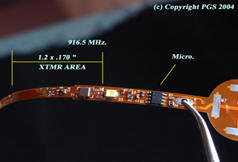
PGS Active RFID tag systems offer a complete solution. to RFID integration. With a standard range capability of over 350 feet and battery life up to 5 years, this system provides the customer with options previously not available with traditional passive RFID tag technology. Passive tags typically are limited to no more than 2 meters (6 feet) and usually only perform well only within 2 feet. PGS Active RFID systems also include true anti-collision algorithms and can read up to 50 tags per second in multiple tag environments. A Windows Application package is also available for fast integration to existing company network systems.
System - Operational Description
ONLY THREE COMPONENTS
RFID TAGS
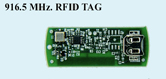
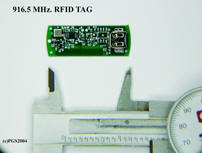
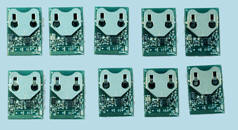 The RFID Tags operate on a single 3 volt Lithium coin cell. They are programmed to output data bursts that are received by the RFID Reader. The interval between bursts can be varied from continuous to several hours. In addition a data encoded Low Battery condition is programmable depending on anticipated battery capacity. (This is related to burst interval requirements.) A Sensor Detect input is also provided for remote switch monitoring. PGS RFID Tags incorporate proprietary anti-collision schemes and forward error correction (FEC). In a multiple Tag environment - 50 RFID Tags can be read per second. The RFID Tags operate on a single 3 volt Lithium coin cell. They are programmed to output data bursts that are received by the RFID Reader. The interval between bursts can be varied from continuous to several hours. In addition a data encoded Low Battery condition is programmable depending on anticipated battery capacity. (This is related to burst interval requirements.) A Sensor Detect input is also provided for remote switch monitoring. PGS RFID Tags incorporate proprietary anti-collision schemes and forward error correction (FEC). In a multiple Tag environment - 50 RFID Tags can be read per second.
RFID TAG READER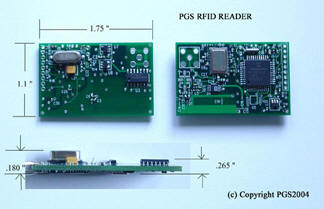
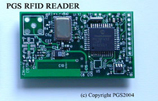
The RFID TAG READER Circuit is comprised of a Receiver, Microprocessor, and reader transmitter. The receiver decodes, stores RFID IDs, and outputs real time Tag data. RFID Tag entry, and exit times are logged. The real time data stream may be binary encoded or ASCII at 115.2 KBPS User selectable. The PGS Readers can have form factors varying from fixed locations to handheld devices.
SOFTWARE
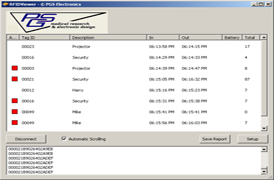
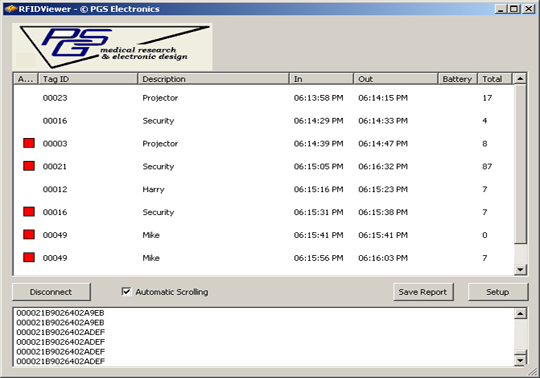
WINDOWS COMPATIBLE click to see example � PGS has developed a Windows (2000 / XP) compatible program that provides the customer with RFID tag data management and data logging. Tag identification, User/Product name, Time In, Time out, Sensor / Alarm condition, and battery life are easily viewed with this program.
WEB VIEWER
PGS can give clients the ability to monitor the TAG Data from any web connected computer. This provides the customer with access to the Tag data from any location that is IP enabled (internet or intranet).
SPREAD SPECTRUM REPEATER
In locating, asset management, and muster scenarios RFID tag information may need to be sent to a remote central station(s). PGS provides a wireless 1 � 20 mile spread spectrum link capable of true peer to peer MESH network transfer of data. The RFID tag READERS can transfer local RFID tag data through a daisy chain network to the remote central station.
FUNCTIONAL DESCRIPTION
The RFID Tag can be set to a range of between 3 and 300 feet. When the RFID Receiver detects a Tag it first determines if the decoded ID is a valid Tag ID. At this point, the reader stores the tags entry and exit time in its database and also provides a real time data stream to a host computer.
GENERAL SOFTWARE DESCRIPTION:
RECEIVER STATES
1. SLEEP MODE �
System is asleep, running on 32KHz clock. Program is running looking for proper header from a valid tag.
POWER CONSUMPTION 200 ua. 10:1 duty cycle (Receiver requires this and is on all the time)
2. WHEN A TAG COMES INTO RF DETECTION RANGE �
Microprocessor running at 32 kHz. Sees tag header Valid and wakes up to full speed. Sends data output in ASCII format to hosts Microprocessor.
POWER CONSUMPTION = 12 ma when decoding.
3. SYSTEM RETURNS TO SLEEP MODE - when no tag is in view.
PERFORMANCE:
PGS RFID READERS -have the ability to read TAGS at approximately 50 tags / second if all tags are transmitting continually. However, some clients RFID tags will have a short duty cycle requirement. For Example, 1 transmission every 5 seconds. In this situation the acquisition of tag IDs requires considerable more time in the presence of multiple tags. At 5-second intervals, this would require approximately 15 seconds to get all 50. This is a function of statistical probability. The anti-collision algorithm predicts that no two tags will collide two times in a row.
PROXIMITY / ANTI COLLISION ALGORITHM
Tags can be placed directly on top of each other. A seeded proprietary random transmission pattern is incorporated in the PGS RFID Transmitter protocol. This anti-collision feature insures that no two specific tags collide in any 2 sequential transmitter bursts. Bursts are approximately 7.5 ms long. By nature of an active tag and proprietary transmitter design PGS RFID TAGS do not become desensitized, off frequency or de-tuned when in close proximity. Further, the Radiation pattern is close to isotropic so tags are �seen� by the reader at relatively the same distance in any orientation. (No nulls)
GENERAL SPECIFICATIONS:
RFID READER:
FREQUENCY 916.5 MHz.
BOARD SIZE 1.9 x 1.3 inches Approximate
RECEIVER SENSITIVITY - 110db
SELECTIVITY +/- 150 kHz Saw Filter Front End.
POWER (3-Volt Internal Reg.)
RFID TAG:
FREQUENCY 916.5 MHz.
BOARD SIZE 1.5 x .62 x .2 inches
STABILITY SAW STABILIZED +/- 100 KHz.
ID NUMBER Over 2 million unique IDs
POWER CR 2430 or smaller 3 volt Lithium **
POWER CONSUMPTION 150 ua. To 3 ma.
SLEEP 2 ua.
DESCRIPTION � Main Screen
The above screen is showing 8 RFID tags. No tags are ACTIVE (within a readers range) at this point. 5 Tags are showing an alarm condition. This represents that one or more of the sensor switches on the tags has been activated. For example, Projector # 03 may have been moved from its location. Security # 21 may have entered a restricted area. Mike has made 2 excursions into a restricted area. No battery alarms are present. Time in and out of reader range is logged as well as the total time. Security Tag # 21 was in for the longest at 87 seconds. Automatic scrolling has the capacity for 500 or more tags in the data base which can be reviewed at any time.
TAG ENTRY WINDOW: Tag description
DESCRIPTION
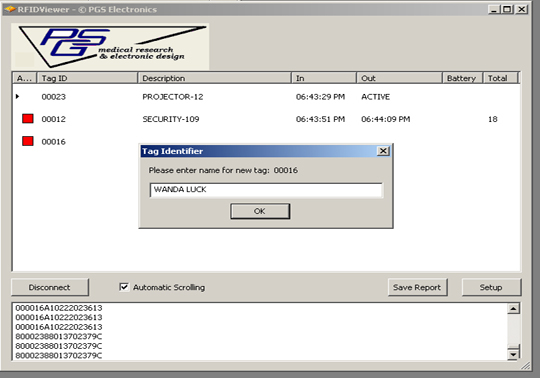
This screen represents what happens when a previously unknown RFID Tag comes into view. (Tag # 16 was deliberately erased in the data base so that it appears �new�). Tag # 16 came into view of the reader and is not in the data base. The software prompts the user to name the tag. From this point on the reader will display the typed name for Tag # 16 whenever Tag # 16 is in view. The bottom window is a real time display of the complete TAG ID with Error Correction. This is a hexadecimal number representing the 32bit Tag id and error detection code.
Note that RFID Tag # 23 assigned to projector 12 is ACTIVE. This means the projector is in the proper readers range and is being detected.
|